
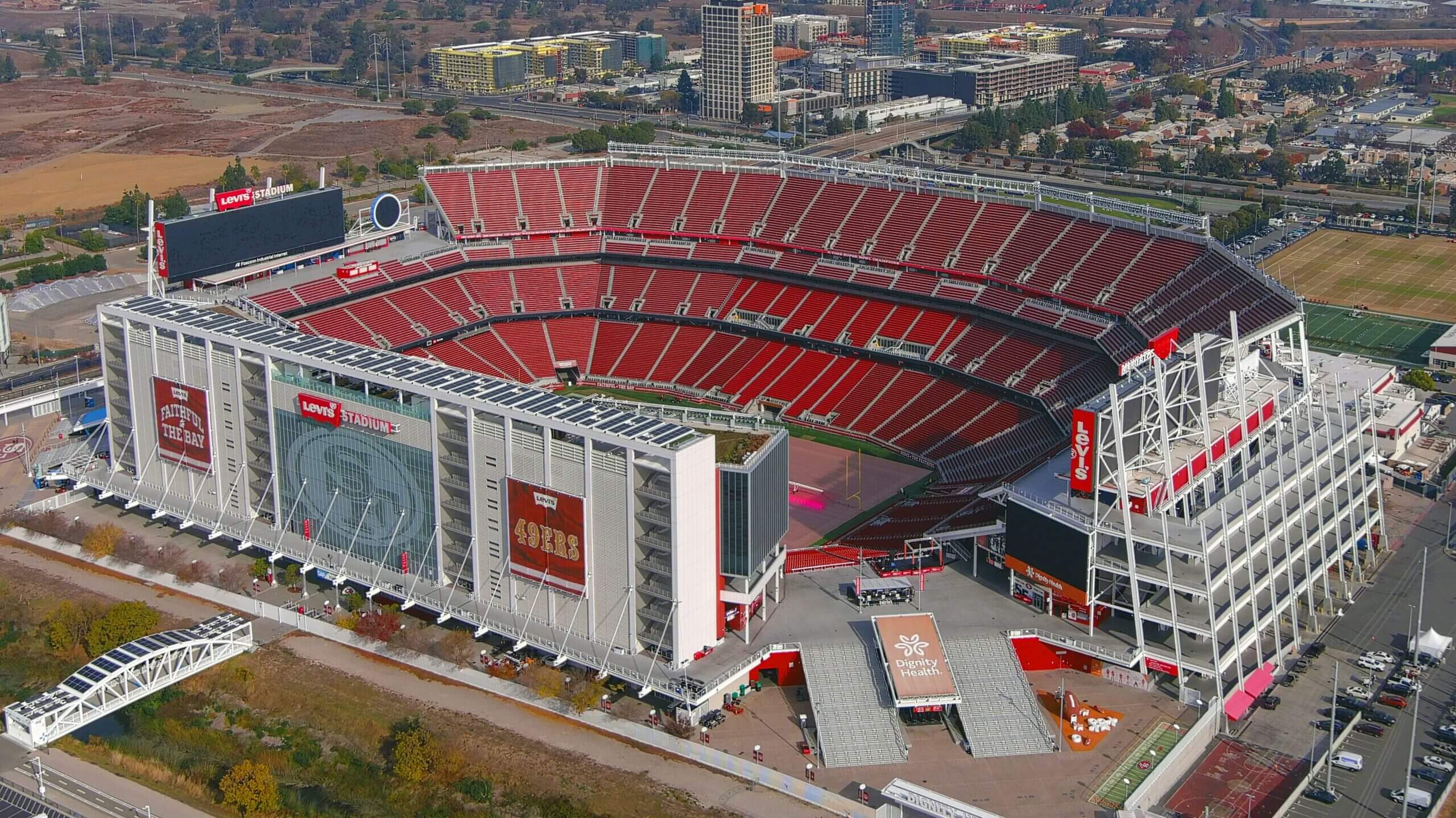
For decades, Candlestick Park was home to the San Francisco 49ers. But as the stadium aged, the team looked for a future-ready venue that could match both the demands of the sport and the spirit of Silicon Valley.
VISION TO REALITY
The search ended in Santa Clara, where bold vision and community partnership gave rise to Levi’s Stadium—a world-class facility that set a new benchmark for modern sports arenas.
In May 2009, the City of Santa Clara approved the agreement that made the stadium possible. By April 19, 2012, shovels broke ground, and just over two years later, on July 17, 2014, Levi’s Stadium officially opened its doors.
Few projects of this scale move with such speed and precision. The result is a 1.85 million-square-foot arena with a capacity of 68,500 seats, two-thirds of which are located in the lower bowl to maximize the fan experience.
The first official event wasn’t football—it was an MLS soccer match on August 2, 2014. Later that fall, the stadium officially became the home of the 49ers, ushering in a new era for both the franchise and the city.
THE TEAM THAT MADE IT HAPPEN
Behind every great landmark are visionaries who shape it. Levi’s Stadium was no exception. Jed York, President and CEO of the 49ers, provided the leadership to transition from Candlestick to Santa Clara. Gideon Yu, a former 49ers executive, secured record-breaking financing that accelerated construction by a full year.
On the design and build side, HNTB Architects led the creative vision, while construction was executed through the Turner/Devcon joint venture, powered by Gary Filizetti’s leadership at Devcon Construction. Filizetti’s steady hand ensured the stadium rose on schedule and to the highest standard.
Once the doors opened, operational excellence fell under leaders like Nelson Ferreira, whose event and stadium management continues to deliver world-class experiences.
Together, these individuals blended ambition, expertise, and community spirit to deliver more than a stadium—they delivered a legacy.
Key People:
Jed York — CEO, San Francisco 49ers
Nelson Ferreira — Vice President of Stadium and Event Operations, Levi’s Stadium
Gary Filizetti — President, Devcon Construction
Gideon Yu — Technology, Media & Sports Investor; 49ers Co-Owner
Kevin Moore — Former City Council Member, City of Santa Clara
HNTB Architects — Designers of Levi’s Stadium
GREEN, SMART, AND UNFORGETTABLE
Levi’s Stadium was designed with Silicon Valley’s innovation mindset. It became the first NFL stadium to achieve LEED Gold certification, with features such as:
Solar energy panels that help power games and events.
Recycled water systems to minimize waste.
A green roof atop the suite tower.
Faithful Farm, one of the first rooftop farms in any stadium, producing fresh vegetables used in premium concessions.
These features made Levi’s Stadium not only an entertainment hub but also a model of environmental responsibility.
THE SAN FRANCISCO 49ERS: A NEW ERA
Levi’s Stadium stands as a modern monument to the 49ers’ storied legacy, blending tradition with innovation. More than a venue, it reflects the evolution of a franchise defined by iconic moments, championship success, and enduring pride.
Designed as a state-of-the-art facility, the stadium represents an ambitious step into the future while honoring the team’s historic past. It brings generations of fans together and serves as a powerful symbol of progress, passion, and the continued pursuit of excellence.
THE 49ERS DYNASTY
Founded in 1946 and named after the Gold Rush prospectors of 1849, the San Francisco 49ers are deeply rooted in Northern California history. After years at Kezar Stadium, the team moved to Candlestick Park in 1971, where a legendary dynasty was born. Under coaches Bill Walsh and George Seifert, and with icons such as Joe Montana, Jerry Rice, Steve Young, and Ronnie Lott, the 49ers won five Super Bowl championships between 1981 and 1994.
Despite its iconic status, Candlestick Park became known for harsh weather and swirling winds. By the early 2000s, the aging venue lacked modern amenities like luxury suites, premium seating, and spacious concourses, making a new stadium essential for the franchise’s future.
THE JOURNEY TO SANTA CLARA
Plans for a new San Francisco stadium near Candlestick Point collapsed due to political obstacles and funding disputes. After years of failed proposals, the 49ers turned their attention southward to Santa Clara, positioning themselves closer to Silicon Valley and their existing training facilities. In 2010, Santa Clara voters approved the stadium measure, and construction on the $1.3 billion project began in April 2012.
A TECHNOLOGICAL SHOWCASE
Levi’s Stadium opened on July 17, 2014, with its first regular season game on September 14 against the Chicago Bears. Named after San Francisco’s iconic Levi Strauss & Co., which secured naming rights in a $220 million, 20-year deal, the 68,500-seat venue was designed as a technological marvel perfectly suited to its Silicon Valley location.
The stadium boasts the NFL’s largest green roof at 77,000 square feet, extensive solar panels for sustainability, and world-class Wi-Fi connectivity enabling fans to stream replays and interact via apps throughout games. Other features include luxury suites, 7,500 premium club seats, and a 20,000-square-foot 49ers museum celebrating the team’s rich history with interactive exhibits.
MAJOR EVENTS AND CHALLENGES
Though less than a decade old, Levi’s Stadium has already hosted landmark events including Super Bowl 50 (2016), WrestleMania 31 (2015), Copa América Centenario (2016), and the 2019 College Football Playoff National Championship. The venue regularly hosts international soccer matches and concerts, establishing itself as a premier entertainment destination.
The transition hasn’t been without challenges. The 40-mile move from San Francisco sparked debates about the team’s identity, while early concerns about field conditions, excessive heat in certain sections, and higher ticket prices altered the traditional fan experience. The corporate atmosphere contrasted sharply with Candlestick Park’s gritty intimacy.
Despite these growing pains, Levi’s Stadium has proven financially successful and became an economic catalyst for Santa Clara. As the 49ers pursue their sixth Super Bowl championship, this state-of-the-art facility stands as both a tribute to the franchise’s championship legacy and a foundation for future greatness in the Bay Area.